Home Blog Page 3

Murshidabad — The Forgotten Capital That Once Ruled Bengal

0

Murshidabad, a name often lost in the footnotes of mainstream Indian history, was once the beating heart of Bengal. During the 18th century, this town stood tall as a symbol of administrative might, cultural fusion, and economic opulence. Once the capital under the Nawabs of Bengal, it served as a critical node in the trade networks of South Asia and beyond. Today, it lies quiet along the Bhagirathi River in West Bengal, a town of echoes and crumbling glory, waiting to be remembered.

This is not just another old town. Murshidabad’s faded havelis, grand palaces, and silent mosques hold within them stories of power, betrayal, artistry, and spirituality—an entire era embedded in brick and stone.

The Rise of Murshidabad as Bengal’s Capital

Murshidabad did not emerge overnight. Its rise was gradual and deeply strategic. When Nawab Murshid Quli Khan, the Subahdar (governor) of Bengal, Bihar, and Orissa, decided to move the capital from Dhaka to this quieter part of Bengal in the early 1700s, he saw potential. Positioned advantageously along the Bhagirathi River, Murshidabad was close to major trade routes while offering a buffer from coastal threats like pirates and European naval forces.

This move transformed a modest village into a sprawling administrative and commercial capital. The city was named after the Nawab himself, and under his rule, it flourished economically. Silk weaving, ivory carving, metalworks, and fine muslin production found a nurturing ground here. Merchants from Persia, Armenia, and Europe set up establishments, and Murshidabad’s name became synonymous with prosperity.

Hazarduari Palace — The Thousand-Door Marvel

A tour of Murshidabad is incomplete without stepping into the iconic Hazarduari Palace. Built in 1837 by Duncan Macleod during the rule of Nawab Nazim Humayun Jah, this massive European-style structure was meant to reflect the modernity and power of the Nawabs, even under British dominance.

The name Hazarduari means “a palace with a thousand doors”, though not all are real—many are cleverly designed to confuse potential intruders. The palace served as the royal court and was also used to host dignitaries and European officials. Today, it houses a museum featuring over 20,000 artifacts—swords, portraits, letters, manuscripts, and ornate furniture. The palace stands as a powerful reminder of how Murshidabad attempted to balance Indian legacy with colonial presence.

Katra Mosque — Where Power Meets Piety

If the Hazarduari Palace shows the administrative might of the Nawabs, the Katra Mosque reflects their spiritual grounding. Built in 1723 by Nawab Murshid Quli Khan, it served both as a mosque and a madrasa. The structure, made of bricks and lime, is an impressive example of Mughal-Islamic architecture. It once featured two grand minarets, of which only parts remain due to earthquake damage.

The most fascinating element? The Nawab’s own grave lies under the mosque steps. His wish was to be buried beneath the feet of those who came to pray—an act of humility uncommon among rulers of his stature. The Katra Mosque today stands as a spiritual anchor in Murshidabad’s story, still visited by devotees and history enthusiasts.

Murshidabad’s Golden Silk — Weaving Wealth and Prestige

During its golden years, Murshidabad was known across the globe for its silk. The Murshidabad mulberry silk, light and lustrous, was prized by traders from Europe, the Middle East, and Southeast Asia. Local artisans crafted sarees, scarves, and textiles that adorned courts and palaces from Delhi to London.

The silk industry brought in enormous revenue, supporting not only artisans but also the wider economy of Bengal. British and French trading companies set up factories (trading posts) in the region. Even today, the region continues silk production, though on a diminished scale, with heritage weavers in nearby villages keeping the tradition alive.

The Turning Point — The Battle of Plassey

No account of Murshidabad is complete without understanding the blow it suffered in 1757. The Battle of Plassey, fought a short distance away, was less a military clash and more a political betrayal. Nawab Siraj-ud-Daulah, Murshidabad’s last independent Nawab, was defeated not by British military strength but by treachery from within his own ranks, most notably by Mir Jafar.

This battle handed Bengal over to the British East India Company, marking the beginning of two centuries of colonial rule. Murshidabad was quickly reduced from a power center to a puppet seat, as political control shifted to Calcutta. While the city retained symbolic importance for some time, its economy and stature were systematically dismantled.

Cossimbazar and the Mansions of Trade

Adjacent to Murshidabad lies Cossimbazar, once a bustling trade hub. This area was home to wealthy merchants—Armenians, Jains, and Bengalis—who built sprawling mansions with intricate woodwork and elaborate courtyards. Many of these buildings now lie in ruins, with moss-covered facades and collapsing staircases silently telling the tale of lost wealth.

Some heritage conservation groups have started restoring parts of Cossimbazar, and its unique blend of architectural styles (Persian, Rajasthani, British) makes it a hidden treasure for architectural enthusiasts.

Murshidabad Today — A Living Museum

Modern Murshidabad is a mix of quiet life and ghostly grandeur. The roads are not packed with tourists. Instead, one finds school children walking past ancient structures, artisans still weaving silk, and imams delivering sermons in centuries-old mosques.

Restoration projects have begun to pick up pace, supported by historians, NGOs, and even descendants of the Nawabi families. The town is increasingly being recognized for its potential as a heritage tourism destination, not just within India but also globally.

Despite years of neglect, Murshidabad retains a magnetic charm. Its narrow alleys, arched gateways, and weathered inscriptions feel like an open book, each page revealing new perspectives on India’s layered past.

Why Murshidabad Still Matters

In a world that often flattens history into simplistic timelines, Murshidabad offers complexity. It represents the opulence of pre-colonial India, the early impact of British expansion, and the deep cultural fusion between Persian, Bengali, and European influences.

For scholars, it is a treasure trove of primary sources. For travelers, it is an escape into an immersive historical landscape. For locals, it remains a source of pride, identity, and artistry.

Final Thoughts

Murshidabad may no longer echo with the footsteps of emperors or resonate with political debate, but it continues to whisper its story to those who care to listen. It is a reminder that power can fade, but legacy lingers. In a nation racing toward the future, Murshidabad urges us to look back—not with nostalgia, but with respect and renewed curiosity.

Whether you’re a history lover, a culture buff, or simply an explorer of forgotten places, Murshidabad deserves a place on your map.

Python Basics for Data Science MCQ Questions and Answers Part – 2

0

Python Basics for Data Science MCQ Questions and Answers Part – 1 

Python Basics for Data Science MCQ Questions and Answers Part – 2

Section 6: Advanced Machine Learning (51-70)

  1. What is the purpose of train_test_split() in Scikit-learn?
  • a) Splitting DataFrames
  • b) Splitting a dataset into training and testing sets
  • c) Filtering missing values
  • d) Performing PCA
    Answer: b) Splitting a dataset into training and testing sets
  1. What is the main advantage of using Principal Component Analysis (PCA)?
  • a) Increases data dimensionality
  • b) Reduces dimensionality while preserving variance
  • c) Improves feature importance
  • d) Converts numerical data to categorical
    Answer: b) Reduces dimensionality while preserving variance
  1. Which function is used to encode categorical variables in Scikit-learn?
  • a) StandardScaler()
  • b) OneHotEncoder()
  • c) MinMaxScaler()
  • d) LabelBinarizer()
    Answer: b) OneHotEncoder()
  1. What is the purpose of cross_val_score() in Scikit-learn?
  • a) Finds the best hyperparameters
  • b) Performs cross-validation
  • c) Trains a deep learning model
  • d) Computes classification accuracy
    Answer: b) Performs cross-validation
  1. Which ensemble method combines weak learners to form a strong learner?
  • a) Boosting
  • b) PCA
  • c) K-Means
  • d) Cross-validation
    Answer: a) Boosting
  1. What is an imbalanced dataset?
  • a) A dataset with missing values
  • b) A dataset where one class has significantly more samples than another
  • c) A dataset without categorical variables
  • d) A dataset with equal class distribution
    Answer: b) A dataset where one class has significantly more samples than another
  1. Which method is used to handle imbalanced datasets?
  • a) Feature scaling
  • b) SMOTE (Synthetic Minority Over-sampling Technique)
  • c) PCA
  • d) Cross-validation
    Answer: b) SMOTE (Synthetic Minority Over-sampling Technique)
  1. Which boosting algorithm is widely used for structured data?
  • a) KNN
  • b) XGBoost
  • c) Logistic Regression
  • d) Linear Regression
    Answer: b) XGBoost
  1. What does hyperparameter tuning do?
  • a) Reduces dataset size
  • b) Optimizes model performance
  • c) Increases test accuracy
  • d) Improves data quality
    Answer: b) Optimizes model performance
  1. Which function is used to find the best hyperparameters in Scikit-learn?
  • a) cross_val_score()
  • b) GridSearchCV()
  • c) train_test_split()
  • d) StandardScaler()
    Answer: b) GridSearchCV()
  1. What is feature engineering?
  • a) A machine learning algorithm
  • b) Creating new features from raw data
  • c) Training a deep learning model
  • d) Optimizing hyperparameters
    Answer: b) Creating new features from raw data
  1. Which technique helps reduce overfitting in decision trees?
  • a) Increasing depth
  • b) Pruning
  • c) Adding more features
  • d) Reducing dataset size
    Answer: b) Pruning
  1. What is bagging in ensemble learning?
  • a) Reducing dimensionality
  • b) Training multiple models on random subsets of data
  • c) Applying multiple activation functions
  • d) Combining similar features
    Answer: b) Training multiple models on random subsets of data
  1. What is the primary goal of k-means clustering?
  • a) Group similar data points together
  • b) Perform feature scaling
  • c) Increase accuracy of classification models
  • d) Reduce data redundancy
    Answer: a) Group similar data points together
  1. What metric is commonly used to evaluate clustering performance?
  • a) R-squared
  • b) Silhouette Score
  • c) F1-score
  • d) Accuracy
    Answer: b) Silhouette Score
  1. What is the primary function of a confusion matrix?
  • a) Evaluate classification model performance
  • b) Improve model accuracy
  • c) Transform data features
  • d) Optimize neural networks
    Answer: a) Evaluate classification model performance
  1. Which metric is used to evaluate a regression model?
  • a) Accuracy
  • b) Mean Squared Error (MSE)
  • c) F1-score
  • d) Confusion Matrix
    Answer: b) Mean Squared Error (MSE)
  1. What is the key advantage of using a Random Forest over a single Decision Tree?
  • a) Requires less data
  • b) Reduces overfitting
  • c) Runs faster
  • d) Requires no hyperparameter tuning
    Answer: b) Reduces overfitting
  1. What is the main function of a neural network activation function?
  • a) Introduce non-linearity
  • b) Reduce loss
  • c) Normalize input values
  • d) Increase model size
    Answer: a) Introduce non-linearity
  1. What is dropout used for in deep learning?
  • a) Increase training time
  • b) Improve feature selection
  • c) Prevent overfitting
  • d) Reduce activation function complexity
    Answer: c) Prevent overfitting

Section 7: Deep Learning (71-85)

  1. What is the fundamental unit of a neural network?
  • a) Batch size
  • b) Neuron
  • c) Feature selection
  • d) Gradient descent
    Answer: b) Neuron
  1. What type of activation function is commonly used in hidden layers?
  • a) Sigmoid
  • b) Softmax
  • c) ReLU
  • d) Linear
    Answer: c) ReLU
  1. What is the main function of an optimizer in deep learning?
  • a) Improve model visualization
  • b) Minimize the loss function
  • c) Increase learning rate
  • d) Reduce dataset size
    Answer: b) Minimize the loss function
  1. What is the role of a convolutional layer in a CNN?
  • a) Process textual data
  • b) Detect spatial patterns in images
  • c) Normalize feature values
  • d) Remove overfitting
    Answer: b) Detect spatial patterns in images
  1. What is the primary difference between CNN and RNN?
  • a) CNN is for text, RNN is for images
  • b) CNN is for images, RNN is for sequential data
  • c) CNN is supervised, RNN is unsupervised
  • d) CNN uses more parameters
    Answer: b) CNN is for images, RNN is for sequential data
  1. What is the main challenge of training deep neural networks?
  • a) Lack of training data
  • b) Vanishing gradient problem
  • c) High training speed
  • d) Small dataset sizes
    Answer: b) Vanishing gradient problem
  1. What is the primary function of dropout in neural networks?
  • a) Improve accuracy
  • b) Reduce overfitting
  • c) Increase training speed
  • d) Improve data visualization
    Answer: b) Reduce overfitting
  1. Which optimizer is commonly used in deep learning?
  • a) SGD
  • b) Adam
  • c) Linear Regression
  • d) XGBoost
    Answer: b) Adam
  1. What is the primary role of a fully connected layer in a neural network?
  • a) Reduce overfitting
  • b) Combine learned features for final classification
  • c) Normalize input data
  • d) Generate new data points
    Answer: b) Combine learned features for final classification
  1. What is transfer learning in deep learning?
  • a) Using different datasets for training
  • b) Training a model from scratch
  • c) Reusing a pre-trained model for a different task
  • d) Reducing training time using feature selection
    Answer: c) Reusing a pre-trained model for a different task
  1. Which deep learning framework is widely used for NLP and vision tasks?
  • a) Scikit-learn
  • b) OpenCV
  • c) TensorFlow
  • d) NumPy
    Answer: c) TensorFlow
  1. What is batch normalization used for in deep learning?
  • a) Improve visualization
  • b) Reduce model complexity
  • c) Stabilize and accelerate training
  • d) Improve data augmentation
    Answer: c) Stabilize and accelerate training
  1. What is an epoch in deep learning?
  • a) A new layer in a neural network
  • b) One complete pass through the entire training dataset
  • c) A type of activation function
  • d) A convolution operation
    Answer: b) One complete pass through the entire training dataset
  1. What is the primary advantage of using an autoencoder?
  • a) Increase model accuracy
  • b) Perform unsupervised feature learning
  • c) Improve dataset size
  • d) Reduce overfitting
    Answer: b) Perform unsupervised feature learning
  1. What is reinforcement learning primarily used for?
  • a) Text processing
  • b) Image classification
  • c) Decision-making in dynamic environments
  • d) Data augmentation
    Answer: c) Decision-making in dynamic environments

Section 8: Natural Language Processing (86-100)

  1. What is Tokenization in NLP?
  • a) Splitting text into words or sentences
  • b) Removing stopwords
  • c) Stemming words
  • d) Applying TF-IDF
    Answer: a) Splitting text into words or sentences
  1. What does TF-IDF stand for?
  • a) Term First-In Document Frequency
  • b) Text Feature In-depth
  • c) Term Frequency – Inverse Document Frequency
  • d) Token Feature Index
    Answer: c) Term Frequency – Inverse Document Frequency
  1. What is the purpose of Word2Vec in NLP?
  • a) Convert text into images
  • b) Represent words as numerical vectors
  • c) Classify documents
  • d) Remove stopwords
    Answer: b) Represent words as numerical vectors
  1. Which model is commonly used in NLP for text generation?
  • a) CNN
  • b) Transformer
  • c) K-Means
  • d) Decision Tree
    Answer: b) Transformer
  1. What is the difference between stemming and lemmatization?
  • a) No difference
  • b) Stemming cuts words, lemmatization gives root words
  • c) Lemmatization uses AI
  • d) Stemming is better
    Answer: b) Stemming cuts words, lemmatization gives root words
  1. Which deep learning model is widely used in NLP tasks?
  • a) Decision Trees
  • b) BERT (Bidirectional Encoder Representations from Transformers)
  • c) SVM
  • d) Random Forest
    Answer: b) BERT
  1. What is the primary use of Named Entity Recognition (NER)?
  • a) Detecting sentiment
  • b) Identifying names, locations, and entities in text
  • c) Tokenizing sentences
  • d) Predicting next words in a sentence
    Answer: b) Identifying names, locations, and entities in text
  1. Which NLP technique is used to summarize text?
  • a) Named Entity Recognition
  • b) Text Summarization
  • c) Sentiment Analysis
  • d) Topic Modeling
    Answer: b) Text Summarization
  1. What is the main goal of sentiment analysis?
  • a) Classify emails
  • b) Determine the emotional tone of a text
  • c) Translate text
  • d) Convert speech to text
    Answer: b) Determine the emotional tone of a text
  1. Which of the following is a popular NLP dataset?
  • a) CIFAR-10
  • b) IMDB Reviews
  • c) MNIST
  • d) COCO
    Answer: b) IMDB Reviews
  1. What is BLEU score used for in NLP?
  • a) Evaluate machine translation quality
  • b) Measure topic coherence
  • c) Detect entities in text
  • d) Perform text clustering
    Answer: a) Evaluate machine translation quality
  1. Which language model is used in OpenAI’s ChatGPT?
  • a) CNN
  • b) GPT (Generative Pre-trained Transformer)
  • c) RNN
  • d) LSTM
    Answer: b) GPT
  1. What is Zero-shot learning in NLP?
  • a) Making predictions without prior training on a specific task
  • b) Removing stopwords
  • c) Sentiment analysis
  • d) Topic modeling
    Answer: a) Making predictions without prior training on a specific task
  1. Which framework is used for NLP in Python?
  • a) NLTK
  • b) OpenCV
  • c) TensorFlow
  • d) PyTorch
    Answer: a) NLTK
  1. What is POS tagging in NLP?
  • a) Identifying parts of speech in text
  • b) Detecting named entities
  • c) Summarizing text
  • d) Translating text
    Answer: a) Identifying parts of speech in text

Python Basics for Data Science MCQ Questions and Answers Part – 1

0

Python Basics for Data Science MCQ Questions and Answers Part – 1 

Python Basics for Data Science MCQ Questions and Answers Part – 2

Section 1: Python Basics (1-10)

  1. What is the correct way to declare a function in Python?

    • a) function myFunc():
    • b) def myFunc():
    • c) define myFunc():
    • d) func myFunc():
      Answer: b) def myFunc():
  2. What is the default return type of the input() function?

    • a) Integer
    • b) Float
    • c) String
    • d) List
      Answer: c) String
  3. How do you swap values of two variables a and b in Python?

    • a) a, b = b, a
    • b) swap(a, b)
    • c) a = b; b = a
    • d) swap_values(a, b)
      Answer: a) a, b = b, a
  4. What will print(bool([])) return?

    • a) True
    • b) False
    • c) None
    • d) Error
      Answer: b) False
  5. What keyword is used to define a class in Python?

    • a) define
    • b) class
    • c) structure
    • d) object
      Answer: b) class
  6. What will be the output of print(10 // 3)?

    • a) 3.33
    • b) 3
    • c) 4
    • d) Error
      Answer: b) 3
  7. What method is used to remove an element from a list by its value?

    • a) del list[index]
    • b) list.remove(value)
    • c) list.pop(index)
    • d) list.delete(value)
      Answer: b) list.remove(value)
  8. How do you check if a key exists in a dictionary?

    • a) dict.has_key(key)
    • b) if key in dict:
    • c) dict.exists(key)
    • d) if key present in dict:
      Answer: b) if key in dict:
  9. What does bool({}) return?

    • a) True
    • b) False
    • c) None
    • d) Error
      Answer: b) False
  10. What operator is used for exponentiation in Python?

  • a) ^
  • b) **
  • c) exp()
  • d) //
    Answer: b) **

Section 2: NumPy (11-20)

  1. How do you create a NumPy array with values from 0 to 9?
  • a) np.arange(10)
  • b) np.range(10)
  • c) np.array([0:10])
  • d) np.linspace(0, 9, 10)
    Answer: a) np.arange(10)
  1. What function returns the number of dimensions in a NumPy array?
  • a) array.shape
  • b) array.ndim
  • c) array.size
  • d) array.dim()
    Answer: b) array.ndim
  1. What function is used to calculate the mean of a NumPy array?
  • a) array.avg()
  • b) np.mean(array)
  • c) np.average(array)
  • d) array.mean()
    Answer: b) np.mean(array)
  1. How do you create a 3×3 identity matrix in NumPy?
  • a) np.identity(3,3)
  • b) np.ones((3,3))
  • c) np.eye(3)
  • d) np.matrix(3)
    Answer: c) np.eye(3)
  1. What function computes the sum of all elements in a NumPy array?
  • a) array.sum()
  • b) np.total(array)
  • c) np.sum(array)
  • d) np.add(array)
    Answer: c) np.sum(array)
  1. What is the correct syntax to reshape a NumPy array?
  • a) array.shape(3,3)
  • b) array.reshape((3,3))
  • c) np.reshape(array, (3,3))
  • d) array.resize((3,3))
    Answer: c) np.reshape(array, (3,3))
  1. How do you find the maximum value in a NumPy array?
  • a) array.max()
  • b) np.max(array)
  • c) np.maximum(array)
  • d) array.maximum()
    Answer: b) np.max(array)
  1. What function is used to concatenate two NumPy arrays?
  • a) np.append()
  • b) np.concatenate()
  • c) np.stack()
  • d) np.join()
    Answer: b) np.concatenate()
  1. What function is used to compute the dot product of two NumPy arrays?
  • a) np.product()
  • b) np.dot()
  • c) np.cross()
  • d) np.multiply()
    Answer: b) np.dot()
  1. What function is used to create an array filled with ones?
  • a) np.one()
  • b) np.ones()
  • c) np.fill(1)
  • d) np.unit()
    Answer: b) np.ones()

Section 3: Pandas (21-30)

  1. How do you load a CSV file into a Pandas DataFrame?
  • a) pd.load_csv('file.csv')
  • b) pd.open_csv('file.csv')
  • c) pd.read_csv('file.csv')
  • d) pd.import_csv('file.csv')
    Answer: c) pd.read_csv('file.csv')
  1. How do you check for missing values in a DataFrame?
  • a) df.has_null()
  • b) df.find_missing()
  • c) df.isnull()
  • d) df.missing_values()
    Answer: c) df.isnull()
  1. What function is used to drop missing values in Pandas?
  • a) df.remove_na()
  • b) df.drop_empty()
  • c) df.dropna()
  • d) df.null_delete()
    Answer: c) df.dropna()
  1. How do you select a specific column in a Pandas DataFrame?
  • a) df(column_name)
  • b) df['column_name']
  • c) df.column_name()
  • d) df.select_column('column_name')
    Answer: b) df['column_name']
  1. How do you get the first five rows of a DataFrame?
  • a) df.show(5)
  • b) df.head(5)
  • c) df.top(5)
  • d) df.view(5)
    Answer: b) df.head(5)
  1. What function is used to get summary statistics of a DataFrame?
  • a) df.summary()
  • b) df.stats()
  • c) df.describe()
  • d) df.details()
    Answer: c) df.describe()
  1. How do you rename columns in Pandas?
  • a) df.modify_columns()
  • b) df.rename(columns={'old_name': 'new_name'})
  • c) df.change_column_names()
  • d) df.rename_column('old_name', 'new_name')
    Answer: b) df.rename(columns={'old_name': 'new_name'})
  1. What function is used to sort a Pandas DataFrame?
  • a) df.sorting()
  • b) df.arrange()
  • c) df.sort_values(by='column_name')
  • d) df.order_by('column_name')
    Answer: c) df.sort_values(by='column_name')
  1. What does df.dtypes return?
  • a) Row names
  • b) Missing values
  • c) Data types of each column
  • d) Column count
    Answer: c) Data types of each column
  1. What function is used to reset index in a Pandas DataFrame?
  • a) df.set_index()
  • b) df.remove_index()
  • c) df.reset_index()
  • d) df.index_reset()
    Answer: c) df.reset_index()

Section 4: Matplotlib & Seaborn (31-40)

  1. What does plt.xlabel("X-axis") do?
  • a) Sets the x-axis label
  • b) Sets the y-axis label
  • c) Sets the plot title
  • d) Adds a legend
    Answer: a) Sets the x-axis label
  1. What function is used to display a histogram in Matplotlib?
  • a) plt.hist()
  • b) plt.bar()
  • c) plt.scatter()
  • d) plt.line()
    Answer: a) plt.hist()
  1. Which Seaborn function is used for a box plot?
  • a) sns.plot_box()
  • b) sns.boxplot()
  • c) sns.draw_box()
  • d) sns.plot()
    Answer: b) sns.boxplot()
  1. What function is used to show a legend in Matplotlib?
  • a) plt.names()
  • b) plt.text()
  • c) plt.legend()
  • d) plt.labels()
    Answer: c) plt.legend()
  1. What does sns.heatmap() do?
  • a) Creates a line plot
  • b) Displays a scatter plot
  • c) Visualizes correlations using color maps
  • d) Draws a bar chart
    Answer: c) Visualizes correlations using color maps

Section 5: Machine Learning & Deep Learning (41-50)

  1. What is the purpose of train_test_split() in Scikit-learn?
  • a) Splitting a dataset into training and test sets
  • b) Splitting two DataFrames
  • c) Filtering missing values
  • d) Performing PCA
    Answer: a) Splitting a dataset into training and test sets
  1. What type of machine learning algorithm is LinearRegression()?
  • a) Classification
  • b) Regression
  • c) Clustering
  • d) Dimensionality reduction
    Answer: b) Regression
  1. What is a confusion matrix used for?
  • a) Regression problems
  • b) Evaluating classification models
  • c) Finding missing values
  • d) Plotting data
    Answer: b) Evaluating classification models
  1. What function is used for binary classification in neural networks?
  • a) Softmax
  • b) Sigmoid
  • c) ReLU
  • d) Tanh
    Answer: b) Sigmoid
  1. What is overfitting in machine learning?
  • a) Poor training performance
  • b) Training accuracy is significantly higher than test accuracy
  • c) Good model generalization
  • d) Low variance
    Answer: b) Training accuracy is significantly higher than test accuracy
  1. What is the primary function of an activation function in neural networks?
  • a) Reduce training time
  • b) Introduce non-linearity
  • c) Store training data
  • d) Optimize learning rate
    Answer: b) Introduce non-linearity
  1. Which optimizer is commonly used in deep learning?
  • a) Linear Regression
  • b) Adam
  • c) KNN
  • d) SVM
    Answer: b) Adam
  1. What is the main advantage of using ReLU activation function?
  • a) Reduces training time
  • b) Helps avoid vanishing gradient problem
  • c) Ensures weights remain small
  • d) Normalizes input data
    Answer: b) Helps avoid vanishing gradient problem
  1. What does dropout help prevent in deep learning models?
  • a) Slow convergence
  • b) Overfitting
  • c) Vanishing gradient
  • d) Underfitting
    Answer: b) Overfitting
  1. What does max_depth control in a Decision Tree model?
  • a) The number of nodes
  • b) The maximum depth of the tree
  • c) The number of classes
  • d) The number of features
    Answer: b) The maximum depth of the tree

Rise of DeepSeek – A Deep Dive into the Future of AI Assistance

0

Artificial Intelligence (AI) has revolutionized the way we interact with technology, and DeepSeek is at the forefront of this transformation. As an advanced AI model, DeepSeek is designed to assist users with a wide range of tasks, from answering questions and generating content to solving complex problems. In this blog post, we’ll dive deep into what makes DeepSeek unique, its capabilities, limitations, and how it can be a game-changer for individuals and businesses alike.

What is DeepSeek?

DeepSeek is an AI-powered assistant built on state-of-the-art natural language processing (NLP) and machine learning technologies. It is designed to understand and respond to user queries in a human-like manner, making it an invaluable tool for tasks such as:

  • Content Creation: Writing blogs, articles, and marketing copy.
  • Data Analysis: Interpreting and summarizing complex data.
  • Learning and Research: Providing explanations, definitions, and insights on various topics.
  • Automation: Streamlining repetitive tasks like email drafting, coding, and report generation.

DeepSeek is part of a new generation of AI models that prioritize accuracy, efficiency, and user-friendliness.

Key Features of DeepSeek

1. Natural Language Understanding

DeepSeek excels at understanding context and nuances in human language. Whether you’re asking a simple question or explaining a complex problem, DeepSeek can interpret your input and provide relevant, coherent responses.

2. Multilingual Support

DeepSeek is capable of understanding and generating text in multiple languages, making it a versatile tool for global users.

3. Content Generation

From creative writing to technical documentation, DeepSeek can generate high-quality content tailored to your needs. It can even mimic specific writing styles or tones.

4. Problem Solving

DeepSeek can assist with mathematical calculations, coding challenges, and logical reasoning, making it a valuable resource for students, developers, and professionals.

5. Learning and Adaptation

DeepSeek continuously improves its performance by learning from user interactions. This ensures that it stays up-to-date with the latest trends and information.

Applications of DeepSeek

1. For Businesses

  • Customer Support: Automate responses to common customer queries, reducing the workload on human agents.
  • Marketing: Generate engaging content for social media, blogs, and email campaigns.
  • Data Insights: Analyze large datasets and provide actionable insights for decision-making.

2. For Education

  • Tutoring: Help students understand complex concepts in subjects like math, science, and literature.
  • Research Assistance: Summarize academic papers and provide references for studies.

3. For Individuals

  • Personal Assistant: Manage schedules, draft emails, and provide reminders.
  • Creative Projects: Generate ideas for stories, poems, or art projects.

Limitations of DeepSeek

While DeepSeek is a powerful tool, it’s important to be aware of its limitations:

  1. Knowledge Cutoff: DeepSeek’s training data goes up to October 2023, so it may not have information on events or developments after that date.
  2. No Real-Time Data: It cannot fetch live information from the internet, such as stock prices or breaking news.
  3. Accuracy: While highly accurate, DeepSeek may occasionally generate incorrect or outdated responses.
  4. Bias: Like all AI models, DeepSeek may reflect biases present in its training data.
  5. Complexity: It may struggle with highly specialized or niche topics that require deep expertise.

How to Get the Most Out of DeepSeek

  1. Be Specific: Provide clear and detailed inputs to get the best results.
  2. Verify Information: Always cross-check critical information from reliable sources.
  3. Experiment: Explore DeepSeek’s capabilities by using it for a variety of tasks.
  4. Provide Feedback: Help improve DeepSeek by reporting errors or suggesting improvements.

The Future of DeepSeek

As AI technology continues to evolve, DeepSeek is poised to become even more powerful and versatile. Future updates may include:

  • Real-Time Data Access: Integration with live data sources for up-to-the-minute information.
  • Enhanced Personalization: Tailored responses based on user preferences and behavior.
  • Broader Language Support: Expansion to more languages and dialects.
  • Industry-Specific Solutions: Customized AI models for healthcare, finance, and other sectors.

DeepSeek represents the next step in AI-driven assistance, offering a blend of intelligence, versatility, and accessibility. Whether you’re a business looking to streamline operations, a student seeking help with studies, or an individual exploring creative projects, DeepSeek has something to offer. While it’s not without its limitations, its potential to transform how we work and interact with technology is undeniable.

As we move forward, DeepSeek will continue to evolve, bringing us closer to a future where AI is an integral part of our daily lives. So, why not give it a try and see how it can help you achieve your goals?

What are your thoughts on DeepSeek? Have you used it for any interesting projects? Share your experiences in the comments below! 😊

BRICS Expansion – What the New Members Mean for the Global Economy

The BRICS alliance—comprised of Brazil, Russia, India, China, and South Africa—has been an influential group representing emerging markets with considerable sway in the global economy. In 2024, the alliance expanded, adding several new members: Argentina, Egypt, Iran, Saudi Arabia, the UAE, and Ethiopia. This expansion has sparked discussions about the group’s evolving role on the world stage and the potential economic and geopolitical shifts it might bring. In this blog, we’ll dive into what this expansion means for BRICS and how it may influence the global economy.

The Significance of BRICS and Its Expansion

BRICS initially emerged as an alliance representing large, fast-growing economies outside the Western-centric power structures like the G7. Together, these nations account for over 40% of the global population and approximately 25% of global GDP. Since its inception, BRICS has aimed to challenge Western-dominated economic frameworks, seeking to provide an alternative platform for economic and political collaboration among developing nations.

With the addition of Argentina, Egypt, Iran, Saudi Arabia, the UAE, and Ethiopia, BRICS has significantly broadened its reach. The new members add diversity and unique economic advantages, enhancing the alliance’s potential to reshape global trade patterns, diplomatic relations, and energy dynamics.

Key Implications of the New Members for the Global Economy

The expansion of BRICS brings together some of the world’s largest energy producers, fast-growing markets, and strategically located nations. Here’s how this enlarged alliance could influence the global economy:

Increased Influence Over Energy Markets

With Saudi Arabia, Iran, and the UAE as new members, BRICS now includes three of the world’s leading oil and gas producers. This addition could give BRICS greater control over energy supplies and pricing, rivaling the influence of the West in energy markets.

These countries may align on energy policies that prioritize the interests of oil-producing nations outside of Western influence, potentially reshaping global oil pricing dynamics. Additionally, energy-producing BRICS members could support joint ventures in renewable energy projects, given the global shift toward sustainable energy.

Strengthened Push for De-Dollarization

The original BRICS members had already begun exploring alternatives to the U.S. dollar for international trade, with discussions about a common BRICS currency. Adding countries like Saudi Arabia and the UAE—key players in the global financial system—could accelerate efforts toward de-dollarization.

The new members might favor using their local currencies in bilateral trade within BRICS, reducing dependency on the U.S. dollar and shifting global currency power. This move could gradually impact dollar-dominated markets, especially if oil transactions are shifted away from dollar-based pricing.

Expansion of Trade Routes and Economic Corridors

With members now spread across Africa, Asia, the Middle East, and Latin America, BRICS has the geographic reach to facilitate new trade routes. The inclusion of Egypt, a nation with the Suez Canal, could boost trade efficiency within the BRICS bloc, allowing for easier access to European, Asian, and African markets.

Ethiopia and Egypt bring further African representation, increasing trade links between Africa and other BRICS regions. Africa’s rapidly growing economies, young workforce, and natural resources make it a valuable addition to BRICS’ collective economic potential.

Boosted Infrastructure Investments and Development Initiatives

BRICS, through its New Development Bank (NDB), has provided financing for infrastructure projects and development in member countries. With more members, the NDB could see an expansion of its capital base, enabling larger and more diverse projects.

New members like Argentina and Ethiopia, which need substantial infrastructure improvements, might benefit from NDB-funded projects, potentially reducing their reliance on Western financial institutions. This increased investment can stimulate economic growth in these emerging economies and create new trade opportunities within the BRICS bloc.

Geopolitical Influence in Multilateral Institutions

BRICS’ expansion boosts its leverage in international institutions like the United Nations, the World Trade Organization, and the International Monetary Fund. The inclusion of Iran and Saudi Arabia—two countries with significant geopolitical clout—strengthens BRICS’ voice on issues like sanctions, conflict mediation, and international trade policies.

By uniting more countries outside of Western alliances, BRICS can advocate for reforms in global governance structures to reflect the needs and perspectives of emerging economies. This push could lead to a more multipolar world order, challenging the dominance of Western-led institutions.

Potential Challenges and Limitations

While BRICS’ expansion holds promise, there are challenges to aligning these diverse nations under a cohesive economic and political strategy:

  • Diverse Political Agendas: The new members bring varied political systems and interests, which could complicate consensus on issues. For example, historical tensions between Saudi Arabia and Iran might pose challenges to unified energy or foreign policy stances within BRICS.
  • Economic Disparities: The economic profiles of the new members differ significantly, from the resource-rich Saudi Arabia to Argentina, a nation facing economic instability. Balancing the development priorities of each member could pose a challenge for the BRICS Development Bank and other cooperative efforts.
  • Western Pushback: The expanded BRICS is likely to draw increased scrutiny and pushback from Western countries, particularly the U.S., which may view the alliance as a threat to its economic and political influence. This could lead to heightened competition, including economic sanctions or diplomatic efforts to deter cooperation with BRICS.

The BRICS expansion marks a potentially transformative moment in the global economy, reflecting a shift toward a more multipolar world order. The alliance’s ability to influence energy markets, trade routes, and financial systems could recalibrate power balances that have historically favored the West.

For BRICS to realize its full potential, member nations will need to address internal differences and work collaboratively on shared goals. If successful, the expanded BRICS could offer an alternative model for international cooperation and development, reshaping global trade, finance, and diplomacy. As BRICS continues to evolve, it will undoubtedly be a critical player in the future of the global economy, challenging established norms and potentially bringing about a new era of economic and geopolitical alliances.

Understanding Data Ethics: A Beginner’s Guide

In today’s digital age, data is everywhere. From the websites we visit and the social media posts we like, to the smart devices we use, vast amounts of data are constantly being generated and collected. But with this explosion of data comes the responsibility to use it ethically. Let’s dive into the world of data ethics and understand why it matters to everyone.

What is Data Ethics?

Data ethics refers to the principles and standards that guide the collection, analysis, and use of data. It’s about doing the right thing with data, ensuring that it is used responsibly and with respect for people’s privacy and rights.

Why Should You Care About Data Ethics?

Imagine if someone had access to all your personal information: where you live, your daily routines, your health records, and even your financial details. Without proper ethical guidelines, this data could be misused in ways that harm you. Data ethics ensures that individuals’ privacy is protected and that data is used in ways that benefit society, not harm it.

Key Principles of Data Ethics

  1. Privacy: Respecting an individual’s right to control their personal information. This means not collecting more data than necessary and keeping it secure.
  2. Transparency: Being open about what data is collected and how it is used. People should know what information is being gathered about them and why.
  3. Fairness: Ensuring that data is used in ways that do not discriminate against or harm any group of people. Algorithms and data practices should be designed to be fair and unbiased.
  4. Accountability: Holding organizations and individuals responsible for their data practices. If data is misused, there should be consequences.

Practical Examples of Data Ethics

Let’s look at some everyday scenarios to understand how data ethics plays a role:

  1. Social Media: When you sign up for a social media platform, you share personal information. Ethical platforms will clearly explain how your data will be used and give you control over your privacy settings. They won’t sell your information without your consent.
  2. Healthcare: Medical records contain sensitive information. Hospitals and clinics must ensure this data is secure and only accessible to authorized personnel. Ethical use of healthcare data can improve treatments, but misuse can lead to privacy breaches.
  3. Online Shopping: E-commerce websites collect data on your shopping habits to recommend products. Ethical sites will use this data to enhance your shopping experience without exploiting your preferences or selling your information to third parties without permission.

How You Can Practice Data Ethics

Even as individuals, we can practice data ethics:

  1. Be Informed: Understand the privacy policies of the apps and websites you use. Know what data you are sharing and how it will be used.
  2. Be Selective: Only share personal information that is necessary. Avoid oversharing on social media or online forms.
  3. Demand Transparency: Support businesses and platforms that are transparent about their data practices. If a company isn’t clear about how they use your data, think twice before using their services.
  4. Advocate for Change: Encourage organizations to adopt ethical data practices. Support legislation that promotes data privacy and holds companies accountable.

Data ethics is not just a concern for tech experts or big companies; it affects us all. By understanding and advocating for ethical data practices, we can help ensure that our personal information is used responsibly and that technology serves the common good. Remember, ethical data use is about respect, fairness, and responsibility—principles that benefit everyone in our increasingly digital world.

Tracing the Path of Accounting: From Ancient Origins to Modern Mastery

0

Accounting enjoys a remarkable heritage. The history of accounting is as old as civilisation. The seeds of accounting were most likely first sown in Babylonia and Egypt around 4000 B.C. who recorded transactions of payment of wages and taxes on clay tablets. Historical evidences reveal that Egyptians used some form of accounting for their treasuries where gold and other valuables were kept. The incharge of treasuries had to send day wise reports to their superiors known as Wazirs (the prime minister) and from there month wise reports were sent to kings. Babylonia, known as the city of commerce, used accounting for business to uncover losses taken place due to frauds and lack of efficiency.

In Greece, accounting was used for apportioning the revenues received among treasuries, maintaining total receipts, total payments and balance of government financial transactions. Romans used memorandum or daybook where in receipts and payments were recorded and wherefrom they were posted to ledgers on monthly basis. (700 B.C to 400 A.D). China used sophisticated form of government accounting as early as 2000 B.C. Accounting practices in India could be traced back to a period when twenty three centuries ago, Kautilya, a minister in Chandragupta’s kingdom wrote a book named Arthashasthra, which also described how accounting records had to be maintained.

Luca Pacioli’s, a Franciscan friar (merchant class), book Summa de Arithmetica, Geometria, Proportion at Proportionality (Review of Arithmetic and Geometric proportions) in Venice (1494) is considered as the first book on double entry bookkeeping. A portion of this book contains knowledge of business and book-keeping. However, Pacioli did not claim that he was the inventor of double entry book-keeping but spread the knowledge of it. It shows that he probably relied on then–current bookkeeping manuals as the basis for his masterpiece. In his book, he used the present day popular terms of accounting Debit (Dr.) and Credit (Cr.). These were the concepts used in Italian terminology.

Debit comes from the Italian debito which comes from the Latin debita and debeo which means owed to the proprietor.

Credit comes from the Italian credito which comes from the Latin ‘credo’ which means trust or belief (in the proprietor or owed by the proprietor.

In explaining double entry system, Pacioliwrote that ‘All entries… have to be double entries, that is if you make one creditor, you must make some debtor’. He also stated that a merchants responsibility include to give glory to God in their enterprises, to be ethical in all business activities and to earn a profit. He discussed the details of memorandum, journal, ledger and specialised accounting procedures.

Accounting cycle – Steps involved in the Accounting process

0

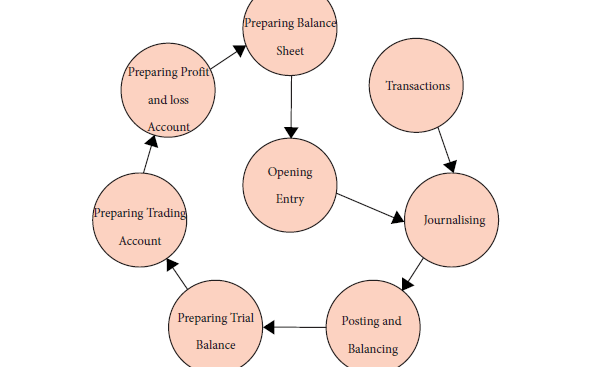
Accounting cycle is the sequence of steps involved in the accounting process. Accounting cycle starts with the identification and recording of financial transactions of an organisation and ends with the preparation of final accounts for the accounting year. The cycle continues for the next accounting year with the opening balances of assets and liabilities which are the closing balances of the preceding year. The steps involved are

1 Identifying the transactions and Journalising

The first step in the accounting process is identifying the financial transactions of a business. All the monetary transactions are recorded in the books of original entry called journals. Recording the transactions in the journal is called journalising. Entries are made in the journals on the basis of source documents in the chronological order, i.e., the order of occurrence of the transactions.

2 Posting and balancing

Transferring the entries from the journal to the ledger is called posting. In the ledger, entries are made in each account after classifying them under common heads. Finding the difference between the total of the debit column and credit column of all the ledger accounts is called balancing.

3 Preparation of trial balance

The list of ledger balances namely trial balance is prepared as the next step. On the basis of ledger balances the financial statements are prepared.

4 Preparation of trading account

Next step is preparation of trading account for a particular accounting period. All the direct revenues and direct expenses are transferred to trading account. The balance in the trading account is the gross profit or gross loss.

5. Preparation of Profit and Loss Account

Profit and loss account is prepared next for a particular accounting period. All the indirect revenues and indirect expenses along with gross profit or gross loss are transferred to profit and loss account. The balance in the profit and loss account is the net profit or net loss.

6 Preparation of balance sheet

A statement showing the balances of assets and liabilities namely balance sheet is prepared as the final step in the accounting process. It is prepared on a particular date, normally, on the last day of the accounting period. The closing balances of an accounting year are taken as the opening balances for the next accounting year. The transactions identified and recorded for the next year are followed by posting and other steps.

The results are communicated to the users of accounting information for the purpose of analysis and decision making.

Data Cleaning and Preprocessing with Python

0

In the fast-paced world of data science, the phrase “garbage in, garbage out” holds more weight than ever. The success of any data-driven project heavily relies on the quality of the data it is built upon. This is where data cleaning and preprocessing come into play. In this article, we’ll delve into the essential steps and techniques for data cleaning and preprocessing using Python, the powerhouse programming language for data science.

Why Data Cleaning and Preprocessing?

Before we dive into the nitty-gritty details, let’s understand the importance of data cleaning and preprocessing. Raw data is often messy, containing errors, missing values, outliers, and inconsistencies. Cleaning and preprocessing help enhance data quality, making it suitable for analysis and modeling. These steps are critical for extracting meaningful insights and building robust machine learning models.

Getting Started: Setting up Your Environment

Before we begin cleaning and preprocessing, ensure you have the necessary tools installed. Popular Python libraries for this task include Pandas, NumPy, and Scikit-learn. Use the following commands to install them:

python
pip install pandas numpy scikit-learn

Step 1: Exploratory Data Analysis (EDA)

Start by gaining a deep understanding of your data through exploratory data analysis (EDA). Use Pandas to load your dataset and perform basic analyses:

python
import pandas as pd

# Load the dataset
data = pd.read_csv('your_dataset.csv')

# Display basic information about the dataset
print(data.info())

# Display summary statistics
print(data.describe())

EDA helps identify missing values, outliers, and patterns within the data, guiding subsequent cleaning steps.

Step 2: Handling Missing Values

Missing data is a common issue in datasets. Address it by either removing or imputing missing values. Pandas provides methods like dropna() and fillna() for this purpose:

python
# Remove rows with missing values
data_cleaned = data.dropna()

# Impute missing values with mean
data_imputed = data.fillna(data.mean())

Step 3: Removing Duplicates

Duplicate records can skew analysis results. Use Pandas to identify and remove duplicates:

python
# Identify and remove duplicates
data_no_duplicates = data.drop_duplicates()

Step 4: Handling Outliers

Outliers can significantly impact statistical analyses and machine learning models. Identify and address outliers using statistical methods or visualization tools like box plots:

python
# Identify outliers using z-score
from scipy.stats import zscore

z_scores = zscore(data)
outliers = (z_scores > 3).all(axis=1)

# Remove outliers
data_no_outliers = data[~outliers]

Step 5: Feature Scaling

Standardize or normalize numerical features to ensure they are on a similar scale. This is crucial for algorithms sensitive to the magnitude of features:

python
from sklearn.preprocessing import StandardScaler

scaler = StandardScaler()
data_scaled = scaler.fit_transform(data[['feature1', 'feature2']])

Step 6: Encoding Categorical Variables

Convert categorical variables into numerical format using one-hot encoding or label encoding:

python
# One-hot encoding
data_encoded = pd.get_dummies(data, columns=['categorical_feature'])

# Label encoding
from sklearn.preprocessing import LabelEncoder

label_encoder = LabelEncoder()
data['categorical_feature'] = label_encoder.fit_transform(data['categorical_feature'])


Data cleaning and preprocessing are indispensable steps in any data science project. Python, with its rich ecosystem of libraries, provides powerful tools to streamline these processes. By following the steps outlined in this guide, you’ll be well-equipped to transform raw, messy data into a clean, structured format ready for analysis and modeling. Remember, a solid foundation of clean data is the key to unlocking meaningful insights and building robust machine learning models. Happy coding!

Machine Learning with Scikit-Learn

0

In the ever-evolving landscape of technology, machine learning stands as a beacon of innovation, transforming the way we approach problem-solving and decision-making. At the forefront of this revolution is Scikit-Learn, a powerful and user-friendly machine learning library in Python. In this article, we’ll delve into the realm of machine learning with Scikit-Learn, exploring its capabilities, ease of use, and its role in democratizing the field of artificial intelligence.

Understanding Scikit-Learn:

Scikit-Learn, often abbreviated as sklearn, is an open-source machine learning library built on NumPy, SciPy, and Matplotlib. Its primary goal is to provide simple and efficient tools for data analysis and modeling, making it accessible to both beginners and seasoned practitioners. With a rich set of functionalities, Scikit-Learn supports various machine learning tasks, including classification, regression, clustering, dimensionality reduction, and more.

Key Features:

  1. Consistent Interface: One of Scikit-Learn’s strengths is its consistent and easy-to-understand API. Regardless of the algorithm or task at hand, the library maintains a uniform interface, streamlining the machine learning workflow.
  2. Comprehensive Documentation: Scikit-Learn boasts extensive documentation, making it an invaluable resource for both newcomers and experienced developers. The documentation provides clear examples, explanations, and guidelines, ensuring that users can harness the full potential of the library.
  3. Versatility in Algorithms: The library supports an extensive array of machine learning algorithms, ranging from classic techniques to state-of-the-art models. This versatility allows users to experiment with different approaches, tailoring their solutions to the specific requirements of each task.

Getting Started:

Installation:

Getting started with Scikit-Learn is a breeze. You can install the library using pip:

bash
pip install scikit-learn

Basic Workflow:

The typical machine learning workflow with Scikit-Learn involves the following steps:

  1. Data Preparation: Load and preprocess the data, handling missing values, scaling features, and encoding categorical variables.
  2. Model Selection: Choose an appropriate machine learning model based on the nature of the problem (classification, regression, etc.).
  3. Training the Model: Fit the selected model to the training data, allowing it to learn patterns and relationships.
  4. Evaluation: Assess the model’s performance on a separate dataset to gauge its generalization capabilities.
  5. Prediction: Deploy the trained model to make predictions on new, unseen data.

Practical Examples:

Let’s consider a couple of practical examples to illustrate Scikit-Learn’s usage:

Example 1: Classification

python
from sklearn.model_selection import train_test_split
from sklearn.ensemble import RandomForestClassifier
from sklearn.metrics import accuracy_score

# Load and preprocess data
X_train, X_test, y_train, y_test = train_test_split(features, labels, test_size=0.2)

# Choose and train a model
clf = RandomForestClassifier()
clf.fit(X_train, y_train)

# Evaluate the model
y_pred = clf.predict(X_test)
accuracy = accuracy_score(y_test, y_pred)
print(f"Accuracy: {accuracy}")

Example 2: Regression

python
from sklearn.model_selection import train_test_split
from sklearn.linear_model import LinearRegression
from sklearn.metrics import mean_squared_error

# Load and preprocess data
X_train, X_test, y_train, y_test = train_test_split(features, labels, test_size=0.2)

# Choose and train a model
regressor = LinearRegression()
regressor.fit(X_train, y_train)

# Evaluate the model
y_pred = regressor.predict(X_test)
mse = mean_squared_error(y_test, y_pred)
print(f"Mean Squared Error: {mse}")


Scikit-Learn has become a cornerstone in the world of machine learning, empowering developers and data scientists to build robust models with ease. Its intuitive interface, extensive documentation, and diverse set of algorithms make it an ideal choice for both educational purposes and real-world applications. As we continue to witness the evolution of machine learning, Scikit-Learn remains a steadfast companion, democratizing the field and bringing the power of AI to the fingertips of all.